Your local Tanzania safari & Kilimanjaro experts
Ranger's Trail Adventures Plan my trip
Kilimanjaro National Park The Only Hut-Based Route

The Complete Marangu Route Guide

Everything you need to know about Kilimanjaro's oldest, most affordable, and only hut-based path to the summit: itinerary options, honest success-rate numbers, difficulty, best time to climb, cost, packing list, and how it compares to every other route. Updated for the 2026/2027 season.

7 min read Updated August 2026 Written by our lead guiding team
5–6 days
Typical duration
45–65%
Summit success range
5,895 m
Uhuru Peak altitude
$1,650+
Starting price, per person
Huts
Only route without tents

What is the Marangu Route

The Coca-Cola Route — Kilimanjaro's original path

"Marangu is the only route where you'll sleep in a bed, not a tent — but it's also the fastest way to run out of time to acclimatize."

The Marangu Route is Kilimanjaro's oldest established climbing path and the only one that uses permanent sleeping huts — Mandara, Horombo, and Kibo — instead of tents. Its nickname, the "Coca-Cola Route," dates back to when bottled soft drinks were sold at these huts, a comfort unavailable on any of the mountain's camping routes.

Marangu also has the gentlest walking gradient of any Kilimanjaro route, and it's the only one where the ascent and descent use the exact same trail — meaning there's no repeated variety in scenery, but also no need to learn two different paths. It's the most affordable and logistically simplest route on the mountain, which makes it popular with budget-conscious climbers and those who prefer the structure of hut accommodation over tented camping.

The trade-off: acclimatization time

The standard 5-day Marangu itinerary offers the least acclimatization time of any route on Kilimanjaro, which is directly reflected in its success rate — the lowest of any standard path. A 6-day version with an added rest day at Horombo Hut significantly improves the odds, and is the version we recommend to nearly everyone considering this route.
Weighing it up

Who the Marangu Route is — and isn't — right for

Marangu's hut-based comfort and gentle gradient suit a specific kind of climber — here's who benefits most, and who should look elsewhere.

!
Choose the 6-day version, not the 5-day

The 5-day Marangu itinerary has a summit success rate of roughly 45% — the lowest of any standard route — simply because it doesn't allow enough time to acclimatize. Adding one extra night at Horombo Hut raises success to roughly 60–65% for a modest increase in cost. We recommend the 6-day version to almost every climber considering this route.

Good reasons to choose Marangu
  • You want hut accommodation rather than tented camping
  • Budget is your primary constraint — this is Kilimanjaro's most affordable route
  • You prefer the gentlest available walking gradient
  • You're combining a short mountain trip with a wider Tanzania itinerary and want the simplest logistics
  • You're climbing with a mixed-ability group where hut structure and shorter days help
Reasons to consider another route instead
  • You want the highest realistic summit odds — Lemosho or Machame outperform Marangu significantly
  • You want varied scenery — Marangu retraces the same trail up and down
  • You want to camp under the stars rather than sleep in a hut dormitory
  • You want the mountain's quietest trail — Marangu sees steady, moderate traffic throughout

Choose your itinerary

5 days or 6 days — which Marangu fits you?

Both itineraries use the same huts and trail. The 6-day version simply adds one rest day at Horombo Hut, which measurably raises summit success.

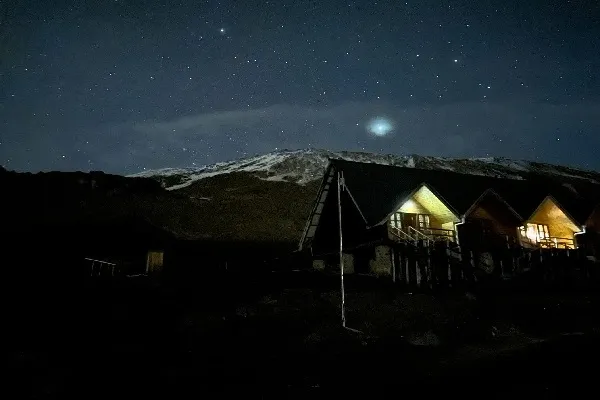
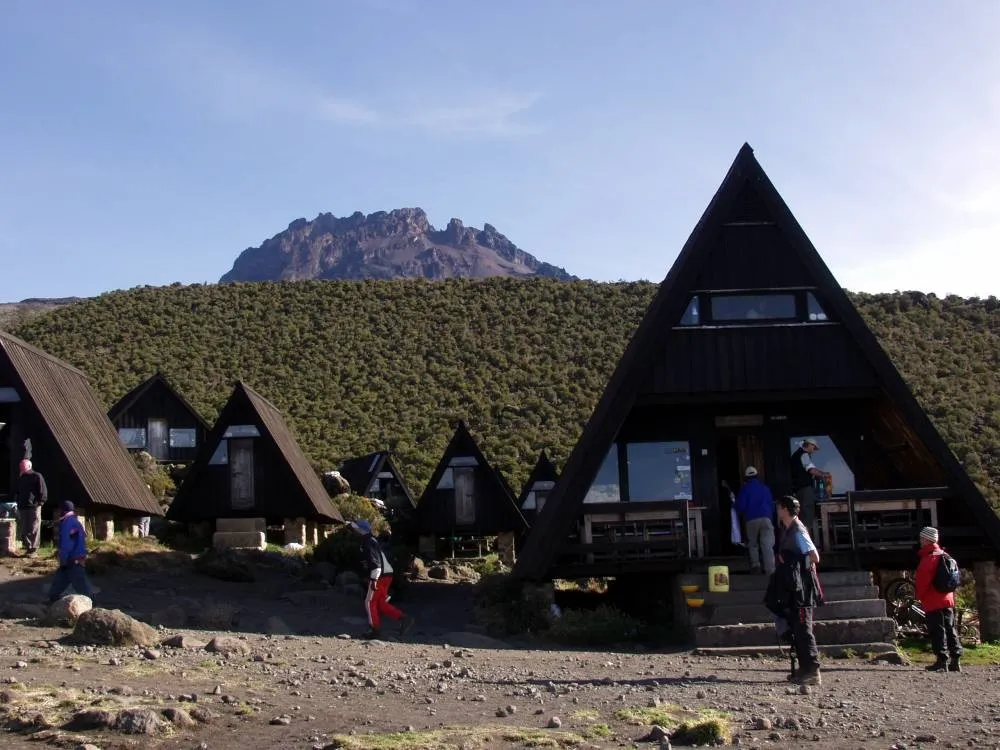
Trekkers on the Marangu Route trail toward Horombo Hut Marangu · Standard
5 Days

Marangu Route — Standard

~45% summit success
  • Same huts and trail as the 6-day version
  • The fastest and most affordable way up Kilimanjaro
  • Only suitable for very fit, well-acclimatized climbers
  • From $1,650 per person
View the 5-day itinerary
Sunrise from Horombo Hut on the Marangu Route's acclimatization day Marangu · With Rest Day
Recommended for most climbers
6 Days

Marangu Route — With Rest Day

60–65% summit success
  • Everything in the 5-day version, plus a Horombo Hut rest day
  • A meaningful jump in summit odds for one extra night
  • Best for most climbers considering this route
  • From $1,850 per person
View the 6-day itinerary

The route, mapped

Elevation profile, both versions

Toggle between the 5-day and 6-day profiles to see exactly where the extra Horombo Hut rest day sits in the schedule.

Day by day

Itinerary snapshot (6-day version)

A condensed view of every day on the trail. For the full hour-by-hour breakdown with schedules and photos, see the dedicated 6-day itinerary page.

1
Marangu Gate to Mandara Hut
3–4 hrs · 8 km · Montane rainforest
2,720 m
2
Mandara Hut to Horombo Hut
5–6 hrs · 12 km · Moorland, first Kibo and Mawenzi views
3,720 m
3
Horombo Hut acclimatization day
3–4 hrs · Day walk toward Zebra Rocks or Mawenzi
3,720 m
4
Horombo Hut to Kibo Hut
5–6 hrs · 10 km · Crossing the Saddle, alpine desert
4,703 m
5
Summit day: Kibo Hut to Uhuru Peak, descend to Horombo
~12–14 hrs · Gillman's Point, Uhuru Peak, descent begins
5,895 m
6
Horombo Hut to Marangu Gate
5–6 hrs · 20 km · Same trail, rainforest descent, certificate
1,860 m

How hard is it

Difficulty and fitness requirements

Marangu has the gentlest walking gradient of any Kilimanjaro route, and hut accommodation removes the physical effort of setting up and breaking down camp each day. No technical climbing or mountaineering experience is required at any point.

The real difficulty on Marangu is altitude, not terrain. The standard 5-day schedule compresses the climb into the fewest days of any route, which is why it also carries the lowest summit success rate. On the 6-day version, the extra Horombo Hut night substantially eases this, though summit night itself — a midnight departure, temperatures below -15°C, and roughly half of sea-level oxygen — is demanding on every Kilimanjaro route regardless of how gentle the days leading up to it feel.

01
Gradient

The gentlest of any standard route — well-graded trail, hut accommodation, no camp setup.

02
Technical difficulty

None — no scrambling, ropes, or climbing gear required anywhere on the route.

03
Altitude challenge

Significant on the 5-day version specifically; meaningfully eased by the 6-day's extra Horombo night.


When to climb

Best months, by conditions

MonthsConditionsRatingNotes
Apr – MayLong rainsAvoidHeaviest rainfall, low visibility, muddy trails
JunDrying outGoodTransitional — trails firming, fewer crowds
NovShort rainsFairBrief afternoon showers, quieter huts
DecDrying outGoodHoliday season, conditions improving

What it costs

Marangu Route pricing, by tier

Hut accommodation is the same fixed standard for every climber on the mountain, regardless of operator — the difference between tiers is guide and crew ratio, meal quality, and group privacy, not the huts themselves.

Standard
$1,650–1,850 pp

Shared hut dormitories, full guide and porter crew, KPAP fair-wage standard, full board meals.

Comfort
$2,100–2,300 pp

Priority hut room allocation, upgraded meal service, extra summit-night support.

Private Premium
$3,100–3,400 pp

Fully private group, dedicated crew, flexible start dates, dedicated hut dining arrangements where available.

Not included in any tier: international flights, the Tanzania tourist visa (approx. $50), travel and medical evacuation insurance, personal gear, and crew tips (approx. $180–280 per climber, pooled).


Preparation

What to pack

Temperatures span 30°C at the gate to -20°C on summit night. Because huts provide a sleeping platform rather than ground insulation, a warm sleeping bag still matters as much as on any camping route.

Upper body
  • Moisture-wicking base layers (2–3)
  • Fleece or softshell mid-layer
  • Insulated down jacket, rated to -20°C
  • Waterproof, windproof outer shell
  • Beanie, sun hat, buff or neck gaiter
  • Liner gloves plus insulated mittens
Lower body & feet
  • Waterproof, broken-in hiking boots
  • Moisture-wicking hiking socks (4–5 pairs)
  • Thermal sleeping socks
  • Waterproof hiking trousers
  • Fleece or thermal trousers, summit night
  • Camp shoes or sandals for the huts
Gear & health
  • 4-season sleeping bag, rated to -20°C
  • Headlamp with spare batteries
  • Trekking poles, recommended
  • 2–3 litre water bladder or bottles
  • Daypack, 30–35 litres
  • High-SPF sunscreen, personal first-aid kit, earplugs for shared dormitories

Route intelligence

Marangu against every other path up

Every route reaches the same summit. Marangu trades scenic variety and summit odds for comfort, simplicity, and price — here's exactly how it stacks up.

RouteDurationSuccess rateCharacterCrowding
Marangu (5 days)5 days~45%Same trail, no rest dayModerate
Umbwe6 days55–65%Steepest, most direct, quietLowest of any route
Machame6–7 days65–75%Steep, scenic, busyHigh
Rongai6–7 days70–83%Only northern route, dry, quietLow
Lemosho7–8 days85–95%Quietest start, most gradualLow, first days
Approximate industry figures, based on multi-operator data. Varies by itinerary, fitness, and season.

In their words

What our Marangu climbers say

★★★★★

"My dad is 63 and this was his first big trek. The huts made it feel manageable for him in a way tents wouldn't have, and the 6-day rest day at Horombo was clearly the right call."

CLAIRE W. — UNITED KINGDOM · 6-DAY, FEBRUARY CLIMB
★★★★★

"We were on a tight budget after a long Tanzania trip and Marangu let us still summit without blowing the whole travel fund. No regrets about doing the same trail twice."

PABLO R. — ARGENTINA · 6-DAY, JULY CLIMB
★★★★★

"Sleeping in an actual bunk after summit night instead of crawling into a cold tent was honestly a bigger relief than I expected. Simple, well-organized route."

ANNA K. — POLAND · 6-DAY, SEPTEMBER CLIMB

Expert answers

Frequently asked questions

  • The Marangu Route is Kilimanjaro's oldest established path and the only route with permanent sleeping huts instead of tents. Nicknamed the Coca-Cola Route for its relative ease of access and long history of use, it climbs and descends the same trail, making it the most affordable and logistically simplest way up the mountain.
  • The nickname dates back to when bottled soft drinks were sold at the mountain huts along this route, a comfort not available on Kilimanjaro's camping routes. It has since come to represent the route's relatively gentle gradient and hut-based, higher-comfort logistics compared to tented alternatives.
  • The 5-day Marangu itinerary has a summit success rate of roughly 45%, the lowest of any standard Kilimanjaro route, because it offers the least acclimatization time. Adding a sixth day with an extra night at Horombo Hut raises success rates to roughly 60–65%.
  • Marangu has the gentlest walking gradient of any Kilimanjaro route and is the only one with hut accommodation, which makes the daily trekking comparatively comfortable. However, its short 5-day itinerary gives the least acclimatization time of any route, so it is not necessarily the easiest route to actually summit — the 6-day version resolves most of this gap.
  • Pricing typically starts around $1,650 per person for a 5-day itinerary and around $1,850 per person for the recommended 6-day version, rising to around $3,400 per person for a fully private premium package. Prices include park fees, hut fees, crew wages, and full board meals on the mountain.
  • Mandara, Horombo, and Kibo Huts are basic dormitory-style shelters with bunk beds, shared dining halls, and separate long-drop or basic flush toilet facilities depending on the hut. They provide a windproof, dry sleeping platform but not heating, so a warm sleeping bag is still essential.
  • Your guide checks blood oxygen twice daily with a pulse oximeter and is trained to spot early symptoms of acute mountain sickness. Mild symptoms are managed with rest, hydration, and pace adjustment; if symptoms escalate, guides descend the climber immediately, regardless of proximity to the summit — a mandatory protocol, not a judgment call. Given the 5-day itinerary's compressed schedule, this vigilance matters even more on that version.

Other Kilimanjaro routes

Lemosho Route guide
Highest success rate

Lemosho Route — The Best First-Timer's Route

From $2,250 · 85–95% success

Read the guide
Rongai Route guide
Guide

Rongai Route — Kilimanjaro's Quiet North

From $1,900 · 70–83% success

Read the guide
Umbwe Route guide
Guide

Umbwe Route — Steepest and Quietest

From $1,850 · 55–65% success

Read the guide

Ready to climb Kilimanjaro's original route?

Tell us your dates and group makeup and we'll help you choose between the 5-day and 6-day Marangu itineraries — no payment required to enquire.

Marangu Route from
$1,650