★★★★★
"Not having to set up camp every night made a real difference for my mother, who joined us at 61. The huts were basic but warm, and the extra day at Horombo clearly helped."
REBECCA N. — CANADA · FEBRUARY CLIMB
The Marangu Route is the only path up Kilimanjaro with permanent hut accommodation. Our 6-day itinerary adds a full acclimatization day at Horombo — the single change that gives this gentle, historic route a real shot at the top.
The route, mapped
The standard Marangu itinerary is 5 days with almost no acclimatization buffer. Adding a sixth day at Horombo, with a day hike up to Zebra Rocks and back, is the single biggest lever available on this route — and the reason we only run the 6-day version.
Why this route
Marangu approaches Kilimanjaro from the southeast, near Moshi, and is the mountain's oldest established route. It's the only itinerary with permanent hut accommodation — shared, dormitory-style rooms at Mandara, Horombo, and Kibo — which means no tents, no camp setup, and simpler logistics than any camping route. That ease of access is also why it's nicknamed the Coca-Cola Route.
Its trade-off is the trail itself: Marangu climbs and descends the same path, so climbers see less varied terrain than on Lemosho or Machame, and the standard 5-day version rushes climbers to Kibo Hut with very little acclimatization time. We only offer the 6-day version, which adds a dedicated day at Horombo — a day hike up to Zebra Rocks at 4,020 m and back down to sleep at 3,720 m — before pushing on to Kibo Hut and summit night.
Bunk beds in shared mountain huts at every camp — no personal tent or sleeping mat required.
Day three is a deliberate out-and-back hike above Horombo, purely to let the body adjust before Kibo Hut.
No technical climbing anywhere on the route, and the most gradual first two days of any Kilimanjaro itinerary.
Route intelligence
Every route reaches the same summit. What differs is how much time your body gets on the way there, and whether you sleep in a hut or a tent — and that shows up directly in success rates.
| Route | Duration | Success rate | Character | Crowding |
|---|---|---|---|---|
| Marangu (6 days) | 6 days | 60–65% | Hut accommodation, same trail both ways | Moderate |
| Marangu (5 days) | 5 days | ~45% | Minimal acclimatization time | Moderate |
| Machame (7 days) | 7 days | 65–75% | Steepest classic route, most scenic | High |
| Lemosho (7 days) | 7 days | 85–90% | Gentler western approach | Low, first 2 days |
| Lemosho (8 days) | 8 days | 92–95% | Most gradual, extra acclimatization night | Low, first 3 days |
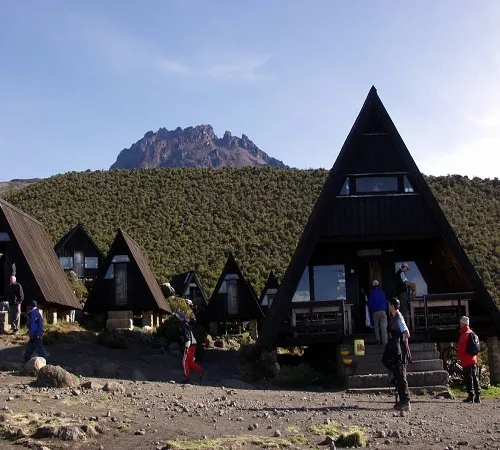 Horombo
Huts
Horombo
Huts Kibo Hut · Sunrise
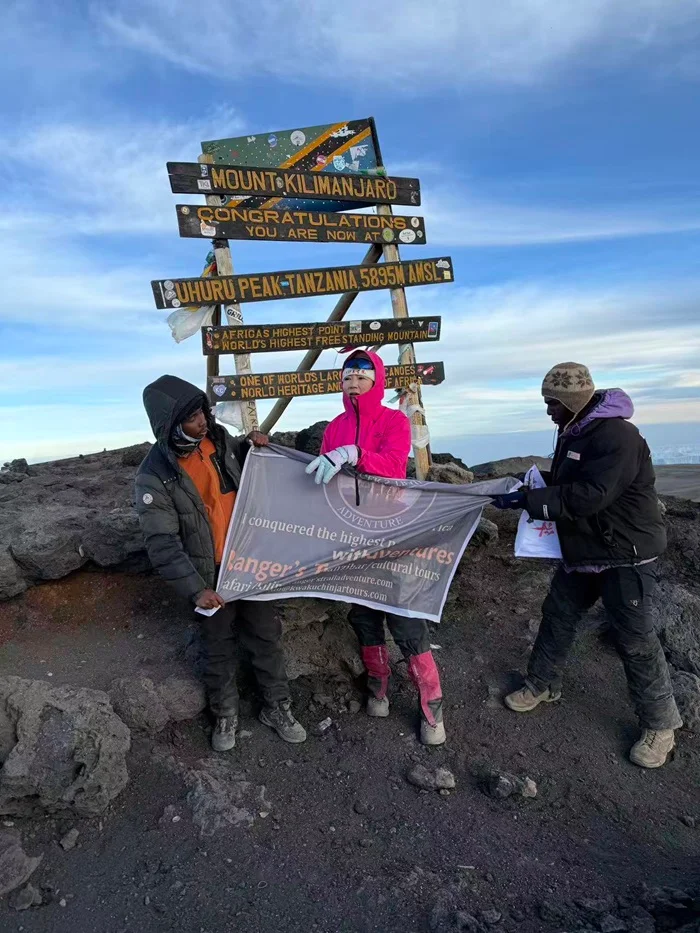 Uhuru Peak
Day by day
Six days, mapped by the elevation you'll actually stand at each night. The watch in the corner tracks your place on the mountain as you scroll — and your booking details are right here whenever you're ready.
A gentle, well-maintained path through dense montane rainforest — the easiest first day of any Kilimanjaro route. Mandara Hut sits right at the forest edge, with a short side trail to the Maundi Crater viewpoint if energy allows.
Meet your guide and crew, then a 45-minute drive to Marangu Gate for registration and park fee processing.
Wide, gently graded forest trail — the gentlest opening day of any route on the mountain.
Bunk-bed dormitory rooms, dining hut, and an optional short walk to Maundi Crater before dinner.
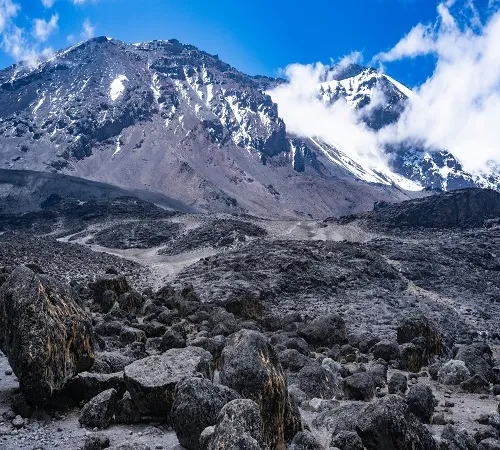
The trail exits rainforest into open moorland, with heather and everlasting flowers replacing the forest canopy. On clear days, both Kibo and Mawenzi peaks come into view for the first time.
Steady, moderate climb through thinning forest into open moorland.
First clear sightlines to Mawenzi's jagged peak and Kibo's dome.
The largest hut complex on the route — this is also where you'll return after summit night.
The day that separates our itinerary from the standard 5-day Marangu climb. A day hike up to the striped Zebra Rocks formation at roughly 4,020 m gives the body a genuine "climb high, sleep low" adjustment before returning to Horombo for a second night.
Gradual climb across alpine desert scrub, with striped volcanic rock formations as the turnaround point.
Water-stained black and white rock face — a natural, unmissable turnaround marker.
Free afternoon for rest, hydration, and recovery ahead of tomorrow's push to Kibo.
The trail crosses the exposed "saddle" between Mawenzi and Kibo, a barren alpine desert with almost no vegetation. Kibo Hut is a stone building at the base of the final summit slopes, where a short rest precedes an early dinner and a midnight wake-up.
Flat, exposed high-desert plain between Mawenzi and Kibo — minimal shelter from sun or wind.
Stone dormitory hut at the foot of the summit slopes. Early dinner and gear check.
Lights out early — summit night departure is typically around 23:30–00:00.
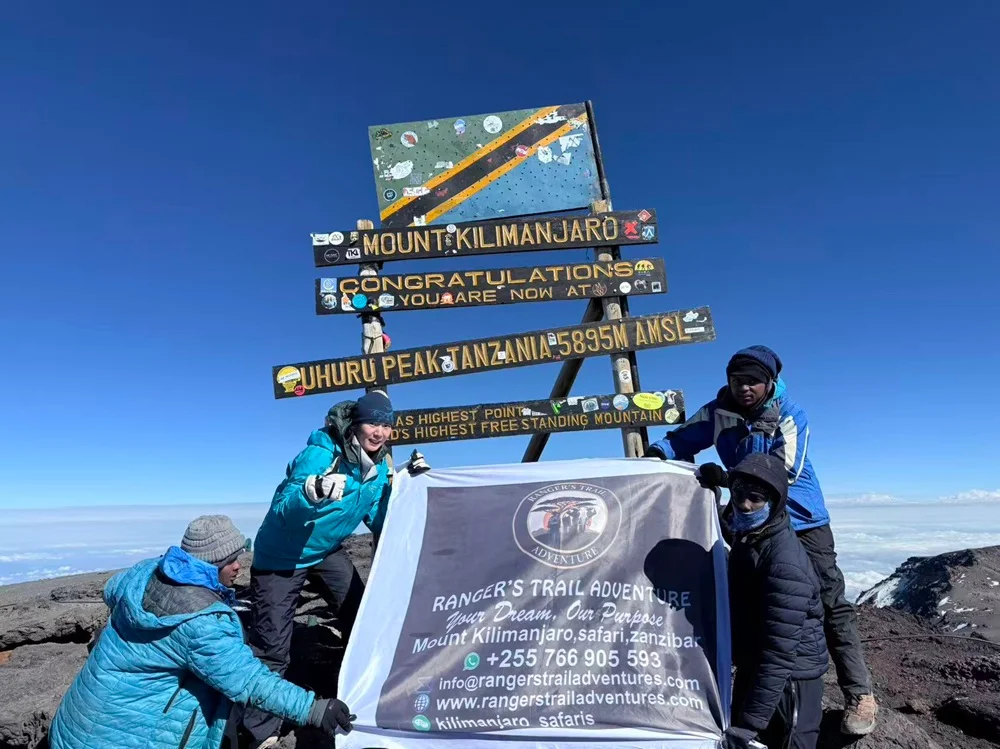
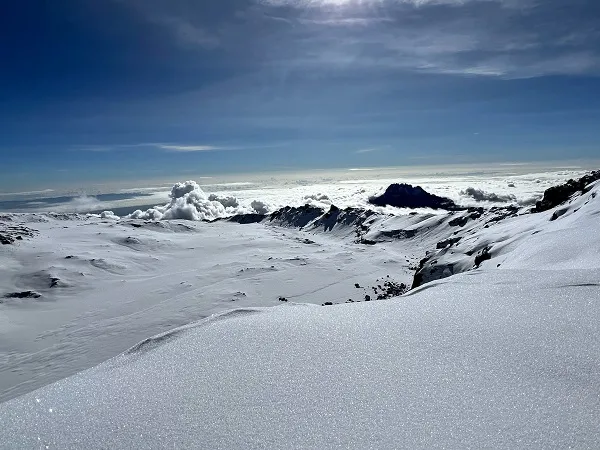
The day the whole itinerary has been building toward. A midnight departure under headlamp climbs steep scree switchbacks to Gillman's Point on the crater rim, then along the glacier edge to Uhuru Peak for sunrise — Africa's highest point. Climbers descend all the way back to Horombo the same day.
Reaching Kibo Hut with an already-acclimatized body — thanks to day three's Zebra Rocks hike — is what separates this itinerary's success odds from the standard 5-day version, where climbers arrive at Kibo Hut with almost no adjustment time before the same summit push.
Full layering system on. Slow, deliberate "pole pole" pace set by the guide — deliberate, not a limitation.
Gillman's Point (5,681 m) meets the crater rim; a further 1.5–2 hours along the rim reaches Uhuru Peak for sunrise.
Fast scree descent to Kibo Hut for a rest and late breakfast, then further down to Horombo Hut for the night.
A long but straightforward final descent, retracing the same trail back through moorland and rainforest to Marangu Gate, where you'll receive your summit certificate. A short transfer returns you to your Moshi hotel by mid-afternoon.
The longest single walking day, retracing days one and two in reverse — mostly downhill.
Gold certificates for Uhuru Peak; green for Gillman's Point.
End of climb services. Asante sana — thank you for climbing with us.
Climb options
Accommodation is identical across all three — shared mountain huts, run by the national park. The difference is guide ratio, group size, and flexibility.
What's covered
Preparation
Temperatures span 30°C at the gate to -20°C on summit night. Layering, not any single item, is what gets you through it. Since huts provide bunks, not bedding, a sleeping bag is still essential. Full kit list and rental options sent after booking.
When to climb
| Months | Conditions | Rating | Notes |
|---|---|---|---|
| Jan – Mar | Dry, cold summit | Excellent | Clear skies, colder nights, fewer climbers |
| Apr – May | Long rains | Avoid | Heaviest rainfall, low visibility, muddy trails |
| Jun | Drying out | Good | Transitional — trails firming, fewer crowds |
| Jul – Oct | Dry, peak season | Excellent | Clearest views, huts can book out early |
| Nov | Short rains | Fair | Brief afternoon showers, quiet, lush |
| Dec | Drying out | Good | Holiday season, conditions improving |
In their words
"Not having to set up camp every night made a real difference for my mother, who joined us at 61. The huts were basic but warm, and the extra day at Horombo clearly helped."
"Reaching Gillman's Point at sunrise after that long, cold final push was the hardest thing I've done. Our guide's pacing from Horombo onward made all the difference."
"I'd read that the 5-day version has a rough success rate and I'm glad we booked the 6-day instead. That Zebra Rocks day felt unnecessary in the moment and essential by summit night."
Expert answers