Your local Tanzania safari & Kilimanjaro experts
Ranger's Trail Adventures Plan my trip
Kilimanjaro National Park Highest Standard Success Rate

The Complete Lemosho Route Guide

Everything you need to know about Kilimanjaro's most scenic and highest-success path to Uhuru Peak: itinerary options, elevation profile, difficulty, best time to climb, cost, packing list, and exactly how it compares to Machame, Rongai, and Marangu. Updated for the 2026/2027 season.

8 min read Updated August 2026 Written by our lead guiding team
7–8 days
Typical duration
85–95%
Summit success range
5,895 m
Uhuru Peak altitude
$2,250+
Starting price, per person
Low
Crowding, first 3 days

What is the Lemosho Route

The route guides recommend, not the one that sells fastest

"Altitude sickness is driven by ascent speed, not fitness. Lemosho simply gives your body more time to catch up — and it happens to be the most beautiful way to do it."

The Lemosho Route starts on Kilimanjaro's remote western flank, near the Tanzania–Kenya border, and climbs through five distinct climate zones — rainforest, moorland, the Shira Plateau's alpine desert, and finally the arctic summit zone — before joining the same final approach used by the busier Machame Route. It is widely considered the most scenic standard route on the mountain, and, on its 8-day itinerary, the highest-success one too.

Because it starts away from the crowded southern gates, the first two to three days on the Shira Plateau are often nearly empty, a genuine rarity on a mountain this popular. Both the 7-day and 8-day itineraries preserve the crucial Lava Tower "climb high, sleep low" acclimatization loop through Barranco and Karanga — the mechanism most responsible for Lemosho's strong success rates.

Why it's often called the best route

No single route is "best" for every climber, but Lemosho combines the widest terrain variety, the quietest early days, and the strongest summit odds of any standard Kilimanjaro itinerary — the trade-off is a longer trip and a higher price than shorter routes like Machame or Rongai.
Weighing it up

Who the Lemosho Route is — and isn't — right for

Lemosho trades trip length and price for the mountain's best combination of scenery and summit odds — here's who benefits most, and who might prefer a different path.

Good reasons to choose Lemosho
  • You want the highest realistic summit success rate of any standard route
  • You want to see the most varied terrain Kilimanjaro has to offer
  • You value quiet, uncrowded trail time — especially the first two to three days
  • You have seven to eight days available and can build a nine- or ten-day trip around it
  • You're prioritizing acclimatization over speed or price
Reasons to consider another route instead
  • You have limited vacation time and need the fastest realistic itinerary — consider Machame or Rongai
  • Budget is the primary constraint — shorter routes cost meaningfully less
  • You want to descend through different terrain than you climbed — Rongai's Marangu-side descent offers that uniquely
  • You're set on Kilimanjaro's single busiest, most social route — Machame sees more climbers and more shared-camp energy

Choose your itinerary

7 days or 8 days — which Lemosho fits you?

Both itineraries follow the same route and camps. The 8-day version simply keeps the Shira Plateau split across two nights instead of one, which measurably raises summit success.

Sunrise over the clouds from Barafu Camp on the Lemosho Route Lemosho · Standard
7 Days

Lemosho Route — Standard

85–90% summit success
  • Same route, camps, and full Lava Tower acclimatization loop
  • The efficient way onto Kilimanjaro's quietest side
  • Best for climbers with limited vacation time or prior high-altitude experience
  • From $2,250 per person
View the 7-day itinerary
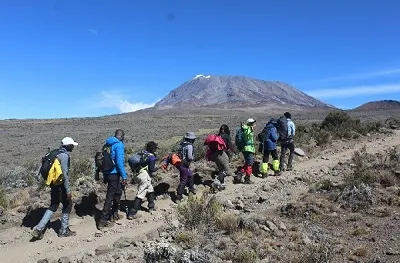
Trekkers crossing the Shira Plateau on the Lemosho Route Lemosho · Full Itinerary
Recommended for most climbers
8 Days

Lemosho Route — Full Itinerary

92–95% summit success
  • Everything in the 7-day version, plus a dedicated Shira Plateau rest day
  • The highest summit success rate of any standard Kilimanjaro route
  • Best for first-time high-altitude trekkers, or anyone wanting maximum odds
  • From $2,450 per person
View the 8-day itinerary

The route, mapped

Elevation profile, both versions

Toggle between the 7-day and 8-day profiles to see exactly where the extra Shira Plateau day sits in the schedule.

Day by day

Itinerary snapshot (8-day version)

A condensed view of every day on the trail. For the full hour-by-hour breakdown with schedules and photos, see the dedicated 8-day itinerary page.

1
Lemosho Gate to Mti Mkubwa Camp
3–4 hrs · 6 km · Montane rainforest
2,835 m
2
Mti Mkubwa to Shira 1 Camp
5–6 hrs · 8 km · Moorland, Shira Plateau edge
3,505 m
3
Shira 1 to Shira 2 — acclimatization day
3–4 hrs · 7 km · "Walk high, sleep low"
3,850 m
4
Shira 2 to Barranco via Lava Tower
6–7 hrs · 10 km · Key acclimatization day
3,960 m
5
Barranco Wall to Karanga Camp
4–5 hrs · 5 km · Southern Circuit
4,035 m
6
Karanga to Barafu Base Camp
3–4 hrs · 4 km · Staging day
4,673 m
7
Summit day: Barafu to Uhuru Peak, descend to Mweka
~15 hrs · Stella Point, Uhuru Peak, descent begins
5,895 m
8
Mweka Camp to Mweka Gate, transfer to Moshi
3 hrs · 10 km · Rainforest descent, certificate
1,640 m

How hard is it

Difficulty and fitness requirements

Lemosho is rated moderate in physical difficulty but is easier on the body overall than shorter routes because of its gradual altitude gain. No technical climbing or prior mountaineering experience is required at any point — the Barranco Wall involves hands-on-rock scrambling but no ropes or climbing gear.

What matters most is a reasonable fitness level and the ability to hike five to seven hours a day for multiple consecutive days, plus the mental resilience for summit night, when temperatures drop below -15°C and oxygen is roughly half of sea-level. We recommend building hiking stamina with multi-hour walks over uneven terrain for two to three months before your climb, ideally with a loaded daypack.

01
Gradient

Gradual and forgiving — spread across seven or eight days rather than compressed into five or six.

02
Technical difficulty

None — no scrambling beyond the hands-on-rock Barranco Wall, and no ropes or gear required anywhere.

03
Altitude challenge

Significant on any Kilimanjaro route, but meaningfully eased by Lemosho's longer acclimatization schedule.


When to climb

Best months, by conditions

The two dry seasons offer the clearest conditions on Lemosho; January–March trades slightly colder summit nights for noticeably fewer climbers than the July–October peak.

Months Conditions Rating Notes
Apr – May Long rains Avoid Heaviest rainfall, low visibility, muddy trails
Jun Drying out Good Transitional — trails firming, fewer crowds
Nov Short rains Fair Brief afternoon showers, quiet, lush
Dec Drying out Good Holiday season, conditions improving

What it costs

Lemosho Route pricing, by tier

Prices below reflect the 7-day itinerary; add roughly $200 per tier for the 8-day version with its extra Shira Plateau rest day. All tiers include park fees, camping fees, crew wages, and full board meals.

Standard
$2,250–2,450 pp

Quality 3-season dome tents, shared. Full guide and porter crew, KPAP fair-wage standard.

Comfort
$2,950–3,150 pp

Larger tents, private toilet tent, hot water daily, extra summit-night support.

Private Premium
$4,100–4,400 pp

Fully private group, dedicated crew, dining tent, flexible start dates.

Not included in any tier: international flights, the Tanzania tourist visa (approx. $50), travel and medical evacuation insurance, personal gear, and crew tips (approx. $220–350 per climber, pooled).


Preparation

What to pack

Temperatures span 30°C at the gate to -20°C on summit night. Layering, not any single item, is what gets you through it.

Upper body
  • Moisture-wicking base layers (2–3)
  • Fleece or softshell mid-layer
  • Insulated down jacket, rated to -20°C
  • Waterproof, windproof outer shell
  • Beanie, sun hat, buff or neck gaiter
  • Liner gloves plus insulated mittens
Lower body & feet
  • Waterproof, broken-in hiking boots
  • Moisture-wicking hiking socks (4–5 pairs)
  • Thermal sleeping socks
  • Waterproof hiking trousers
  • Fleece or thermal trousers, summit night
  • Gaiters, camp shoes
Gear & health
  • 4-season sleeping bag, rated to -20°C
  • Headlamp with spare batteries
  • Trekking poles, strongly recommended
  • 2–3 litre water bladder or bottles
  • Daypack, 30–35 litres
  • High-SPF sunscreen, personal first-aid kit

Route intelligence

Lemosho against every other path up

Every route reaches the same summit. What differs is how much time your body gets on the way there, and how much of the mountain you actually see.

Route Duration Success rate Character Crowding
Lemosho (7 days) 7 days 85–90% As above, without the extra rest day Low, first 2 days
Machame 6–7 days 65–75% Steep, scenic, busy High
Marangu 5–6 days ~45% Same trail up and down, hut-based Moderate
Rongai 6–7 days 70–83% Only northern route, dry, quiet Low
Northern Circuit 9 days 95%+ Full circuit of the mountain Very low
Approximate industry figures, based on multi-operator data. Varies by itinerary, fitness, and season.

In their words

What our Lemosho climbers say

★★★★★

"I'd read that Lemosho's extra day made a real difference and I was skeptical — until I watched two friends on a 6-day Machame itinerary turn back at Barafu while our group summited almost entirely intact."

EMMA T. — CANADA · 8-DAY, SEPTEMBER CLIMB
★★★★★

"Standing at Uhuru Peak at sunrise, above the clouds, with glaciers on either side — I still think about that hour most weeks. Our guide's pacing on summit night made all the difference."

MARCO B. — ITALY · 7-DAY, FEBRUARY CLIMB
★★★★★

"The Shira Plateau days were the surprise highlight — nobody else around, just rolling volcanic grassland with the summit glinting ahead. This route earns its reputation as the best on the mountain."

DR. PRIYA S. — UNITED STATES · 8-DAY, JULY CLIMB

Expert answers

Frequently asked questions

  • The Lemosho Route is widely considered Kilimanjaro's most scenic and highest-success path to the summit. It starts on the mountain's remote western side near the Tanzania–Kenya border, crosses five climate zones from rainforest to arctic summit, and joins the same final approach as the Machame Route while adding extra acclimatization days along the way.
  • Lemosho is typically climbed as either a 7-day or 8-day itinerary. The 7-day version has a summit success rate of roughly 85–90%. The 8-day version adds a Shira Plateau acclimatization day and raises success rates to roughly 92–95%, the highest of any standard Kilimanjaro route.
  • For climbers prioritizing summit success and scenery, Lemosho is generally considered the best all-round route on Kilimanjaro. It combines the highest success rates of any standard itinerary with the most varied terrain and the quietest first few days on the mountain, at the cost of a longer trip and higher price than shorter routes like Machame.
  • The two dry seasons, late June through October and late December through mid-March, offer the clearest skies and most stable conditions on Lemosho. The January–March window sees colder summit-night temperatures but noticeably fewer climbers than the July–October peak season.
  • Pricing typically starts around $2,250 per person for a 7-day Standard Camping package and rises to around $4,400 per person for an 8-day Private Premium package. Prices include park fees, camping fees, crew wages, and full board meals on the mountain.
  • Lemosho is rated moderate in physical difficulty but is easier on the body overall than shorter routes because of its gradual altitude gain. No technical climbing or prior mountaineering experience is required, only a reasonable fitness level and the ability to hike five to seven hours a day for multiple consecutive days.
  • Your guide checks blood oxygen twice daily with a pulse oximeter and is trained to spot early symptoms of acute mountain sickness. Mild symptoms are managed with rest, hydration, and pace adjustment; if symptoms escalate, guides descend the climber immediately, regardless of proximity to the summit — a mandatory protocol, not a judgment call.

Other Kilimanjaro routes

6-day Machame Route
Climb

6 Days Machame — The Whiskey Route

From $1,950 · Steep and scenic

View climb
Rongai Route guide
Guide

Rongai Route — Kilimanjaro's Quiet North

From $1,900 · 70–83% success

Read the guide
Kilimanjaro and Safari combo
Combo

Lemosho Climb and Serengeti Safari

From $4,700 · Summit plus Migration

View combo

Ready to climb Kilimanjaro's most scenic route?

Tell us your dates and fitness level and we'll help you choose between the 7-day and 8-day Lemosho itineraries — no payment required to enquire.

Lemosho Route from
$2,250