★★★★★
"What struck me was how unrehearsed it felt — the group was genuinely tracking, not performing for us. Our guide translated when he could, but a lot of the morning was just walking and watching."
JULIA S. — GERMANY · JULY TRIP
A morning spent walking with a Hadzabe hunting group — one of the last hunter-gatherer communities in Africa — learning traditional bow-hunting, fire-making, and foraging on their terms, with fees paid directly to the community you visit.
Getting there
Lake Eyasi sits well off the main Arusha–Ngorongoro–Serengeti road, which is the honest reason most travelers visit it from Karatu rather than as a standalone day trip from Arusha. Both options are laid out below so you can see the real time cost of each.
Who you'll meet
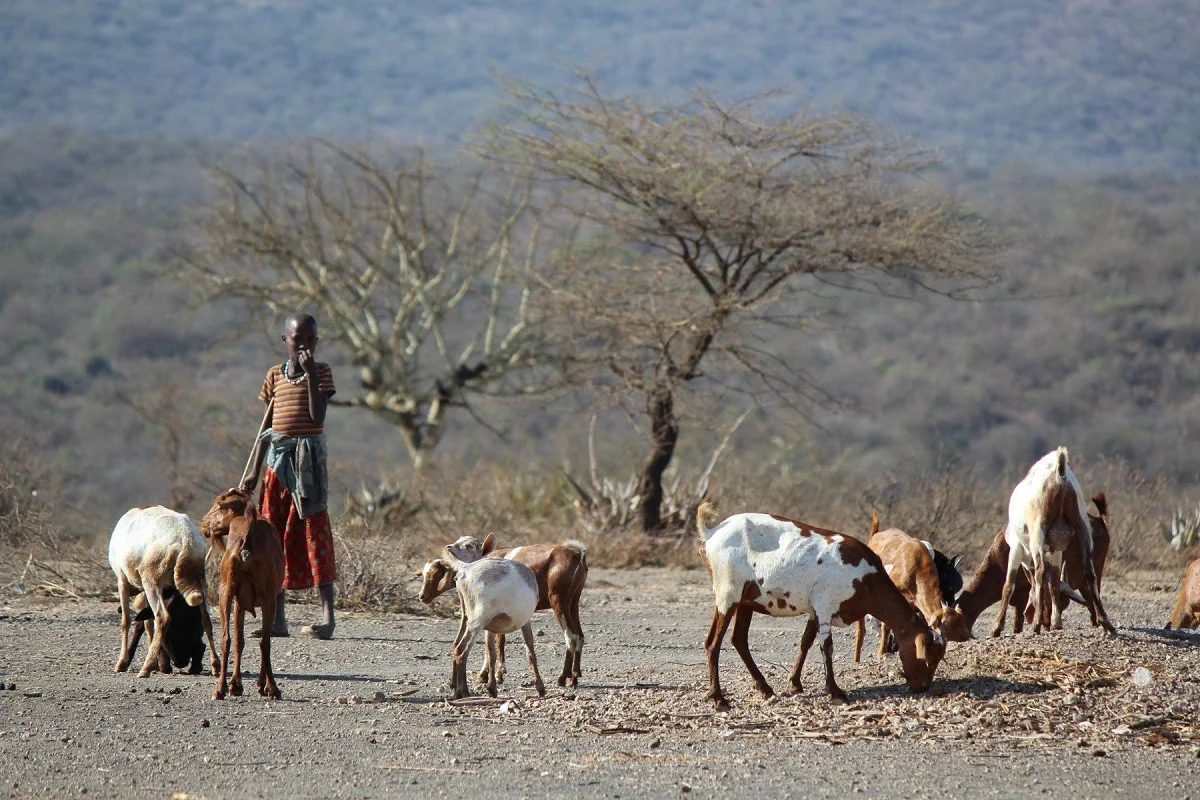
The Hadzabe, also known as the Hadza, are one of the last remaining hunter-gatherer communities in Africa, numbering an estimated 1,000 to 1,300 people living around the shores of Lake Eyasi in the Great Rift Valley. They speak Hadzane, a language with distinctive click consonants unrelated to Tanzania's Bantu languages, and many still hunt with bow and arrow and forage for tubers, berries, and wild honey much as their ancestors did.
A morning walk with a Hadzabe hunting group is arranged directly with the community, not through a staged cultural village. You'll walk with a small hunting party as they track, forage, and demonstrate traditional bow-making and fire-starting — a real activity you're invited into, at their pace, rather than a scripted show timed to your arrival.
Among a small number of communities worldwide still living substantially by hunting and foraging.
Linguistically distinct from surrounding Bantu languages, with consonants produced by clicking sounds.
Not routed through unrelated intermediaries — a distinction worth asking about with any operator you book through.
Trip intelligence
Lake Eyasi's distance from Arusha means the "best" way to visit depends heavily on what else is on your itinerary. Here's how the main options compare.
| Option | One-way drive | Total day length | Best for |
|---|---|---|---|
| From Karatu | ~1.5 hrs | Half-day, relaxed pace | Travelers already near Ngorongoro |
| From Arusha, same day | ~4–4.5 hrs | Very long single day, 10+ hrs | Tight schedules with no Karatu leg |
| Combined with Serengeti | Varies by route | Fits between legs, no extra driving day | Multi-day safari itineraries |
| Overnight at Lake Eyasi | N/A, already there | Unhurried, two visits possible | Photography-focused travelers |
 Lake Eyasi
Basin
Lake Eyasi
Basin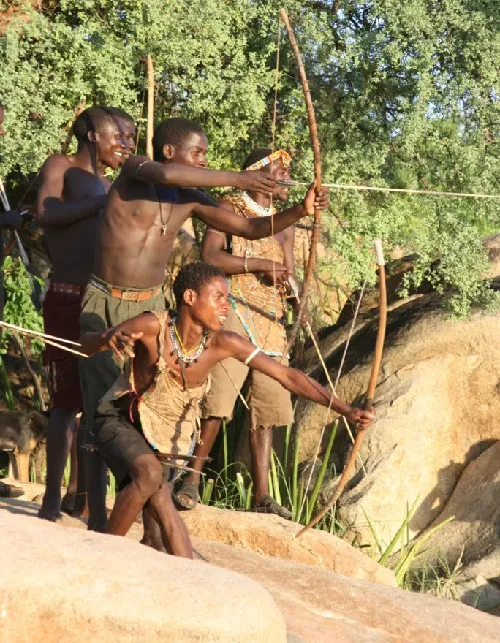 Sunrise, Eyasi
Basin
Sunrise, Eyasi
Basin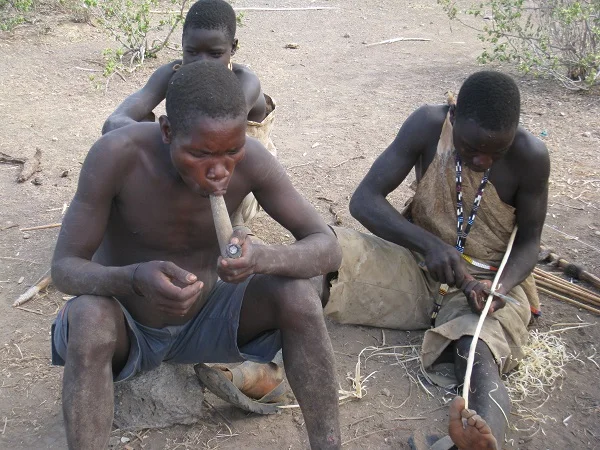 Traditional
Bow-Hunting
Traditional
Bow-HuntingHour by hour
A half-day, mapped by the hour, from an early pickup near Karatu to your return by early afternoon. The clock in the corner tracks where you'd be as the morning unfolds — and your booking details are right here whenever you're ready.
An early start matters here for a different reason than at Ngorongoro — Hadzabe hunting groups head out at first light, so arriving early means joining a real morning hunt rather than a demonstration arranged around a later pickup.
From Arusha, pickup moves to approximately 05:30 to allow for the much longer drive.
A local guide familiar with the community coordinates the visit and community fee handover.
Introductions through the local guide, who often speaks some Hadzane, followed by the community fee handover — paid directly to the group, transparently, before the walk begins.
A brief, informal meeting before the group sets out.
The fee that supports the morning's visit is handed over transparently at this point.
The core of the morning — walking through acacia scrub and open ground alongside the hunting group as they track animal signs, forage for tubers and berries, and identify plants used for food and medicine.
Pace and route are set by the hunters, not a fixed tour path.
Wild tubers, berries, and honey sources pointed out along the way, when found.
A chance to see traditional bow-making and fire-starting by friction, and often to try both under guidance. This portion is more clearly a demonstration than the earlier tracking walk, and is offered at the group's discretion.
Materials, construction, and often a chance to try shooting at a target.
A traditional technique demonstrated, sometimes with visitors invited to attempt it.
The Datoga, a separate pastoralist and blacksmithing community, live nearby and are commonly visited as an add-on after the Hadzabe walk. Blacksmiths there hand-forge arrowheads, knives, and jewelry from scrap metal using traditional bellows.
A separate community fee applies; the visit is entirely optional and can be skipped to end the morning earlier.
A return drive back to Karatu in time for lunch, or on to Arusha for a longer afternoon and evening arrival if visiting directly from town.
Return via the same route toward Karatu or Arusha.
Arusha drop-offs run roughly 2.5 hours later. End of trip services.
Vehicle options
Identical morning and community fee structure across all three — the difference is who you share the vehicle with and where the drive starts.
What's covered
Preparation
This is a walking morning over uneven bush terrain, not a vehicle-based game drive — comfortable footwear matters more here than on a typical safari day.
When to go
| Months | Conditions | Rating | Notes |
|---|---|---|---|
| Jun – Oct | Dry season | Excellent | Easiest walking conditions, roads in good shape |
| Jan – Feb | Short dry spell | Excellent | Good access, fewer travelers in the area |
| Nov | Short rains | Good | Brief afternoon showers, still walkable |
| Mar – May | Long rains | Avoid if possible | Heaviest rainfall, access roads can be difficult |
| Dec | Transitional | Good | Generally favorable conditions |
In their words
"What struck me was how unrehearsed it felt — the group was genuinely tracking, not performing for us. Our guide translated when he could, but a lot of the morning was just walking and watching."
"We asked directly how the fee was distributed before booking and got a straight answer. The Datoga blacksmith visit afterward was a great add — completely different craft and community."
"Going from Karatu rather than Arusha made the whole day far more relaxed — we were back for a late lunch instead of exhausted from an all-day round trip."
Expert answers